No Ordinary Gloves: A 24-Hour Website Case Study
No Ordinary Gloves is a UK glove brand for healthcare, dental, food and industrial teams. This No Ordinary Gloves 24-hour website case study walks through the real project: the brief, what shipped, the pages, the stack, and how the build day was used. It sticks to what the live site shows. There are no invented numbers or quotes here, only the work itself.
If you are a small business in the Philippines wondering whether a fast build can handle a serious brief, this is the project to look at. It is not a one-page promo site. It is a brand with technical products, four audiences and certifications to prove.
The client and the brief
The brief came down to four jobs. The brand sells to four very different industries and needed one site that:
- Looks as premium as the product.
- Explains three glove technologies in plain words.
- Proves its certifications.
- Makes "Request samples" the obvious next step on every screen.
That last point shaped everything. A buyer from a hospital, a dental clinic, a food plant or a factory might land on any page. Wherever they land, the next step is the same: ask for samples.
Why this brief was harder than it looks
Four audiences is the tricky part. A dental buyer and an industrial buyer care about different things, use different words and need different proof. A single generic page would speak to none of them well.
The products are also technical. Glove technologies and certification standards are easy to explain badly, with jargon that loses the reader. The brief asked for plain words.
And trust matters more than usual. Buyers in healthcare and food need to see the right certifications before they will even request a sample. So the site had to put proof where buyers would look for it, not bury it on a back page.
What shipped
Here is what went live on the No Ordinary Gloves site:
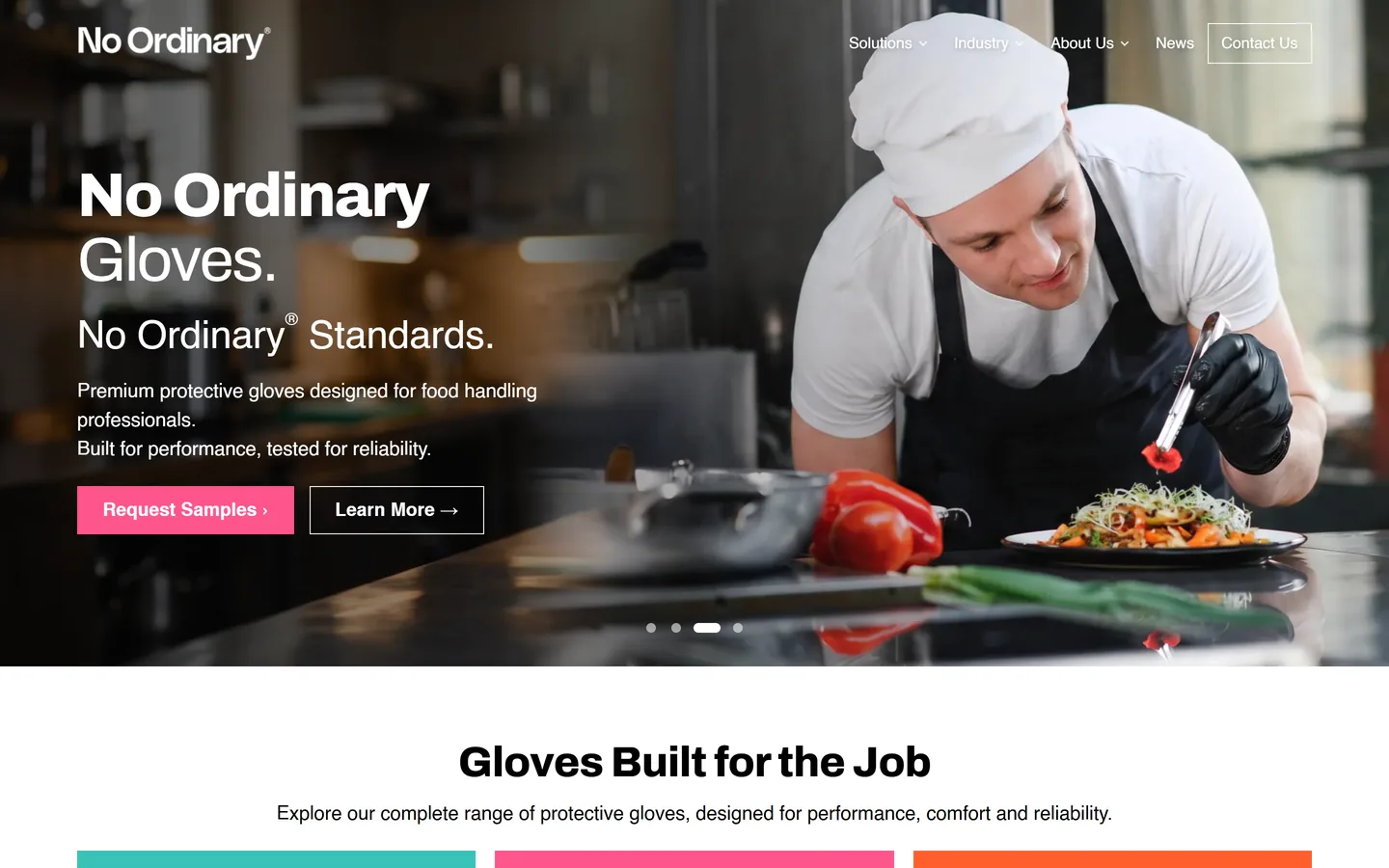
- A full-width hero slider, with one slide per industry.
- A product range with a card for every glove line.
- Industry hubs for healthcare, dental, food and industrial buyers.
- Technology stories for COATS®, Goodpac™ and COATS® Pure.
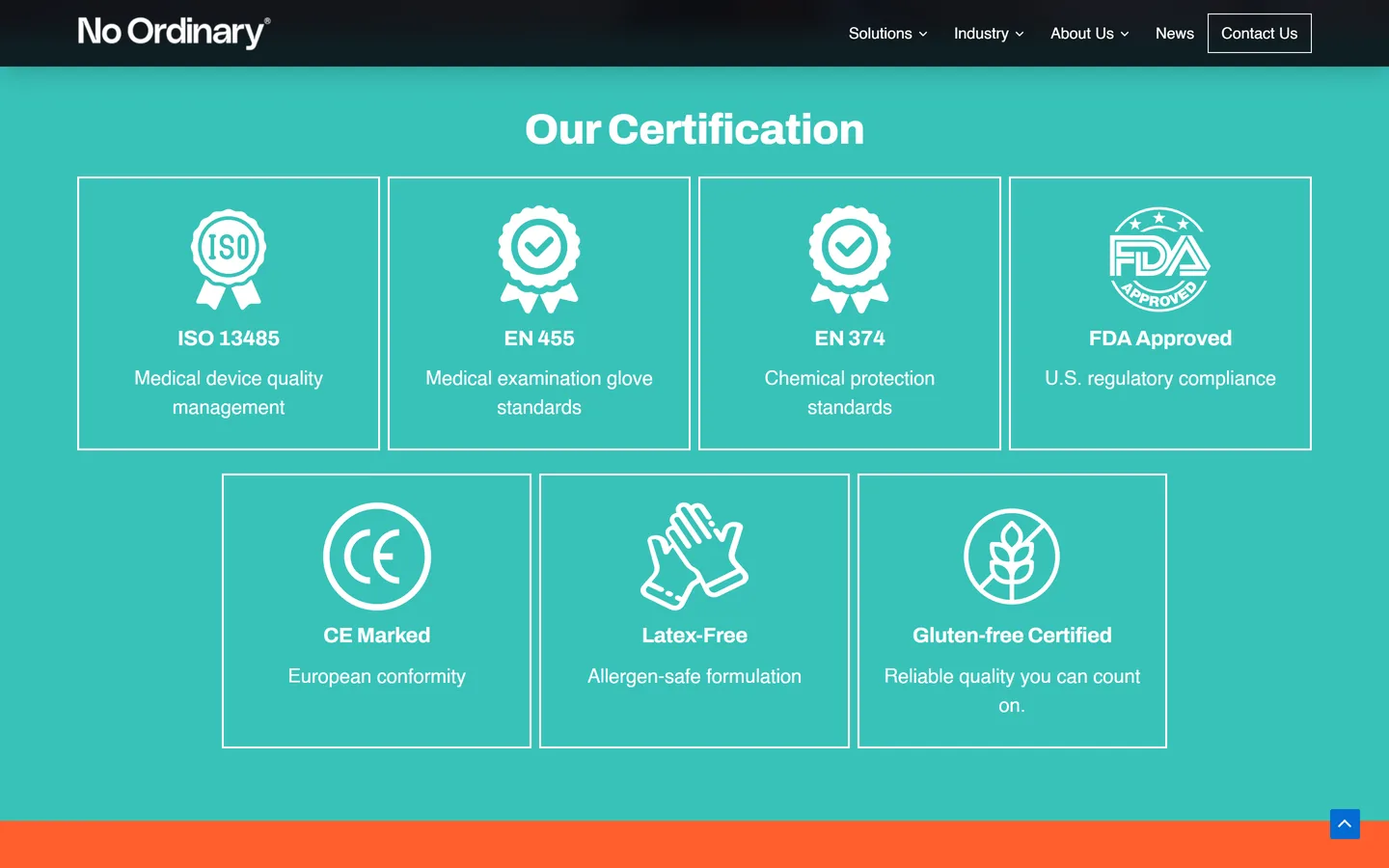
- A certification grid covering ISO 13485, EN 455, EN 374 and more.
- Partner logos, customer reviews and a news feed.
- Sample-request calls to action throughout the site.
- Cookie consent with preferences.
Each item maps back to the brief. The hero slider and industry hubs handle the four audiences. The technology stories handle the plain-words explanation. The certification grid, partner logos and reviews handle trust. The sample-request calls to action handle the one next step.
The pages
The main pages in the site's navigation include:
- Home
- Product range
- Innovation
- Medical, Dental, Food and Industrial, one hub for each audience
- Our partners
- News
- Contact
The structure follows the buyer, not the company org chart. Someone from a dental clinic can go straight to the Dental hub. Someone who wants to understand the technology goes to Innovation. Everyone can reach Contact and a sample request in one or two taps.
The stack
The site runs on WordPress with Elementor. The build includes dropdown navigation to keep the industry hubs and product pages tidy, mobile-first layouts, and cookie consent.
WordPress with Elementor is a familiar setup that lets pages be edited visually after launch. If you already have a design file and want the same kind of result, our Figma to WordPress service turns it into an editable WordPress site.

How the No Ordinary Gloves 24-hour website was built, hour by hour
Every 24-hour website build follows the same schedule. On our service page, each stage is shown with a part of the No Ordinary Gloves site, so here is that schedule with the matching section of this project.
Hour 0: kick-off call
Twenty minutes on the offer, the customers and the one action every visitor should take. For this project, that action was clear: request samples. The brief is confirmed in writing, so the target does not move mid-build.
Hour 2: structure on a phone screen
A wireframe is built phone-first, showing what goes where and why. Every section has to earn its place, or it goes.
Hour 6: design
Colours, type and photos go onto the real layout, and a private preview link lets the client watch sections come alive. The hero slider is the screen we show for this stage.
Hour 10: words and photos
Headlines and sections are written with the client, and every image is prepared, so nothing ships with placeholder text. The product range, with a card for every glove line, is the screen for this stage.
Hour 16: tested on real phones
iPhone, Android, tablet and desktop. Forms, links, speed and spelling are checked against the launch checklist. The phone view of the homepage hero is the screen for this stage.
Hour 21: review round
The client looks over the preview and sends changes, which are made in the same session. The certification grid is the screen for this stage.
Hour 24: live on the domain
Domain connected, HTTPS on, analytics running and Google indexing requested. Logins handed over, and the client owns everything.
What made it work
One action, everywhere
"Request samples" is the obvious next step on every screen. When a site has one clear action, every design decision gets easier, because each section either leads towards that action or it does not belong.
Structure by audience
Four industry hubs mean each buyer finds a page written for them. The hero slider gives each industry its own slide from the first screen.
Plain words for technical products
The COATS®, Goodpac™ and COATS® Pure technology stories explain what each technology is in language a buyer can follow, without a glossary.
Proof in plain sight
The certification grid, partner logos and customer reviews sit on the site where buyers can see them, rather than in a document they have to ask for.
A brief locked before the build
Because the brief was confirmed in writing at the start, the day went into building rather than debating. That is the same reason any 24-hour build is possible at all.
What we are not claiming
This case study reports what shipped. It does not include traffic, sales or ranking figures, because those belong to the client and we will not guess at them. What you can check for yourself is the work: the pages, the sections and the structure described above.
What this means for your business
You may not sell gloves to four industries. But most Philippine small businesses face the same questions on a smaller scale: who visits, what they need to see, what proof will make them trust you, and what one thing they should do next. Answer those in a brief, and a fast build becomes realistic. For a single offer, a website landing page may be enough.
Before your own kick-off call, write down short answers to these:
- Who are your two or three main types of customer?
- What does each of them need to see before they contact you?
- What proof do you have: certifications, reviews, partner logos, photos of real work?
- What is the one action you want every visitor to take?
Bring those answers to the call, and the 20 minutes go much further.
To see how a one-day build compares with a longer project, read 24-hour website vs agency build. To get ready for your own, start with the 24-hour launch checklist.
Frequently asked questions
What platform is the No Ordinary Gloves site built on?
WordPress with Elementor, with dropdown navigation, mobile-first layouts and cookie consent.
Who is the site for?
Buyers in healthcare, dental, food and industrial teams. Each industry has its own hub page and its own slide in the homepage hero.
What is the main call to action?
"Request samples". It is the obvious next step on every screen, so buyers never have to hunt for it.
Why are there no results figures in this case study?
Because we only report what we can show. The pages and sections are visible on the live site, and the client's own figures are theirs to share.
Can my business get a site like this in 24 hours?
A one-page site or a small site of a few pages can be. Larger sites get an honest timeline in the free audit instead.